National Peatland Working Group to Be Established
The Ministry of Environment and Water (MOEW) has committed to including the “Chair Lakes: Biodiversity Hotspots in the Rhodopes” project, implemented by DEVIN and the Bulgarian Biodiversity Foundation (BBF), in Bulgaria’s forthcoming Nature Restoration Plan.
The Ministry will also initiate steps to establish a national working group on peatlands, bringing together public institutions, scientists and businesses to support future research, conservation and restoration efforts for these vulnerable ecosystems.
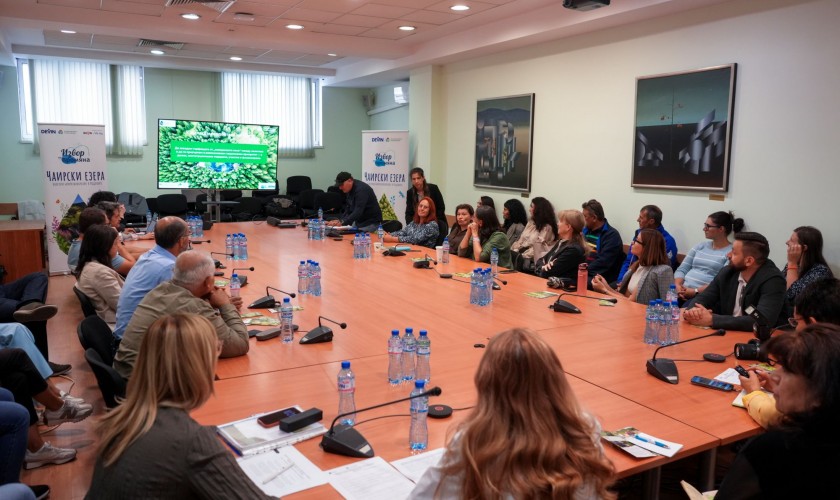
The commitments were discussed on 24 September at a National Round Table on the Conservation and Restoration of Peatlands and Peat-Forming Wetlands in Bulgaria, organised by DEVIN and BBF and hosted by MOEW. The discussion, opened by Deputy Minister Kostadin Geshev, brought together representatives of government institutions, academia, environmental organisations and business.
Despite covering relatively small areas, peatlands play an important role in water management, biodiversity and climate regulation. They store water and act as natural buffers during periods of drought, while remaining highly vulnerable to changes in water regimes, climate impacts and human activity.
“Peatlands in Bulgaria are particularly vulnerable and extremely difficult to restore naturally. We need to strengthen our knowledge of their distribution and condition and develop realistic restoration measures. This round table provides an opportunity to lay the foundations for a coordinated national approach through the exchange of expertise, good practices and effective cooperation,” said Kostadin Geshev, Deputy Minister of Environment and Water.
One of the key challenges identified is the lack of comprehensive information on the location and condition of peatlands across Bulgaria. A national inventory and the use of scientific data to identify priority restoration areas were therefore highlighted as important next steps.
A practical example of turning scientific research into action is the Chair Lakes project, where DEVIN and BBF are working on restoration measures and long-term monitoring. One of the project's key objectives is to expand the Chair Lakes protected area to include the largest peat island in the region, which currently lies outside its boundaries.
“We believe in the power of public-private partnerships and in business creating opportunities for scientists to do their work. As part of the Belgian Spadel Group, DEVIN brings more than 30 years of experience in sustainable water management. Protecting nature and water is part of our DNA, and our natural focus is the Rhodopes, where we operate. We hope that the knowledge generated through the Chair Lakes project will grow into a broader initiative and become part of the Ministry’s future plans,” said Petya Manastirska, Sustainability and Quality Manager at DEVIN.
Fieldwork at Chair Lakes is already generating valuable insights into peatland restoration. Measures include monitoring trees growing on the peat island, removing part of the reed vegetation that was restricting its expansion, and testing innovative methods to better understand organic matter decomposition and carbon retention.
“We have implemented three restoration stages, including monitoring the trees growing on the peat island and removing part of the reed vegetation. We are also testing an innovative method involving buried tea bags to track the decomposition and stabilisation of organic matter and gain insights into carbon retention processes. Expanding the Chair Lakes protected area remains a key priority,” explained Rumyana Ivanova, ecologist at BBF.
During the round table, Hugo Henaff of the Michael Succow Foundation, a partner in the EUKI-funded Future for Peatlands project, presented the European framework for carbon removals and carbon farming (CRCF). Under certain conditions, the framework could enable the emissions reductions achieved through rewetting drained peatlands to be certified, potentially creating an economic incentive for restoring degraded or agricultural peatlands.
The discussions also highlighted the importance of building a comprehensive national knowledge base on peatlands — including their location, current condition and land use — as a prerequisite for effective restoration and future financing mechanisms.
MOEW confirmed that the draft National Nature Restoration Plan has already been submitted to the European Commission. It is expected to be further developed during the assessment and public consultation process in 2027. The Ministry has committed to highlighting the Chair Lakes initiative and the DEVIN–BBF partnership as a good practice example in the future National Plan.
www.devin-bg.com