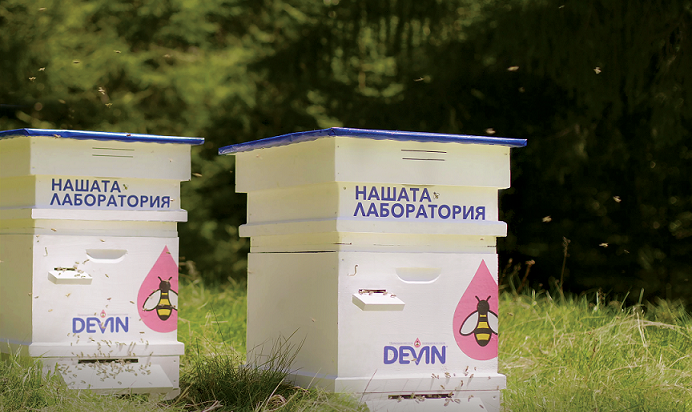
DEVIN Izvorna is the first Bulgarian water brand to actively monitor the environment around its natural spring.
On May 20, we celebrate World Bee Day – a tribute to nature’s buzzing engineers. Today reminds us that protecting bee colonies is vital for our planet’s ecological balance. These tireless pollinators and producers of invaluable gifts double as irreplaceable bio-sensors for the health and purity of our natural resources. This topic has never been more pressing; over the last decade, pesticide use, climate change, and urbanization have pushed bee populations toward extinction in many parts of the world. Yet, science confirms a simple truth: bees are absolutely irreplaceable.
A Bee’s Workday: 200 Flowers and Flights Up to 8 km
The numbers speak for themselves. Bees are responsible for pollinating over 80% of all plants on Earth, including 75% of global crops. In a world without them, we would have to say goodbye to one-third of our favorite foods—including various fruits, vegetables, nuts, and herbs. These would either vanish entirely or become rare luxuries.
Bees pollinate completely naturally, drawn by the sweet nectar of plants. A single bee can fly up to 8 km a day in search of food, cruising at speeds of 17 to 28 km/h depending on its cargo.
Incredible but true: A bee has five eyes—two large compound eyes and three smaller simple eyes (ocelli) in the center of its head. It sports four wings and three pairs of legs, with the hind pair featuring stiff hairs designed to lock in pollen. As they land, pollen grains stick to their antennae and bodies, traveling with them to the next blossom. This is how a single bee visits over 200 flowers a day, pollinating quickly and efficiently.
Pristine Nature? Proven by Bees
In the Devin region, where the majestic Rhodope Mountains offer pristine air, rich biodiversity, and protected water sources, bees have been given an extra, vital role. It is no coincidence that DEVIN Izvorna is the first Bulgarian water brand to go the extra mile in monitoring the ecosystem around its source.
They achieve this through bees, leveraging an innovative method developed by BeeOdiversity, a European leader in environmental biomonitoring. DEVIN Izvorna has placed its own beehives near the spring. Under this European framework, the bees act as natural "sensors," collecting environmental "data." This allows for the early detection of potential pollutants and high-precision biodiversity tracking.
In recognition of these efforts, the environmental organization recently awarded DEVIN Izvorna its third Gold Medal since 2022 for proven excellence in wildlife conservation. This honor stems from BeeOdiversity’s 2025 Annual Report, which confirms a clean, stable, and thriving ecosystem around the Devin spring—completely free of pesticides and heavy metals, and featuring sustainably developing plant species. Yet, the bees' contribution to our world doesn't stop there.
The Taste of Well-being: With Love from the Hive
Renowned for their remarkable social structure, bees never waste time; they spend their lives crafting priceless products for our health and nutrition. Sleeping just 5 to 8 hours a day, they use the sun’s position to navigate. When they discover a rich food source, honeybees perform a signature "waggle dance" to communicate the exact direction and distance to the rest of the colony.
The sweet reward of their labor is, of course, honey. While a few might not have a sweet tooth, most of us adore it. Producing just one jar of honey requires nectar from about 10 million flowers, with a single colony producing around 20 to 30 kg of honey annually.
Honey and propolis are celebrated for their potent antibacterial properties. Royal jelly, packed with vitamins and minerals, delivers an immune system boost. Bee pollen helps alleviate seasonal allergies, while bee venom is widely used to treat arthritis and other inflammatory conditions.
A Buzzing Lesson for the Future
World Bee Day is the perfect moment to remember that human health and nature's well-being are intrinsically linked. Inside a beehive, every single bee has a role, working in perfect harmony with the rest. Perhaps that is their most valuable lesson: a sustainable future is built on cooperation, consistency, and care for the world we share.
As long as the bees continue their tireless flight over the blossoms of the Rhodope Mountains, nature will keep speaking to us through their buzz. We just need to learn how to listen.