The rare peatlands of the Chairite Lakes showcase the power of moss in conserving water, carbon, and biodiversity—the focal point of a long-term initiative by DEVIN and the Bulgarian Biodiver
World Environment Day turns our gaze toward some of the planet’s most unsung ecological heroes: peatlands. In Bulgaria, they blanket a mere 0.1% of the territory, yet they punch far above their weight. These landscapes act as massive carbon vaults, locking away greenhouse gases and curbing climate change. Beyond their cooling power, they serve as sanctuaries for rare flora, vibrant mosses, and a vital rest stop for migratory birds.
A jewel of this natural phenomenon is tucked away in the Western Rhodope Mountains—the Chairite Lakes. This cluster of seven glacial bodies of water hovers between the villages of Trigrad and Mugla, perched at an altitude of 1,360 to 1,460 meters.
At first glance, the Chairite region feels like just another serene mountain getaway. But beneath the placid surface lies a living archive. Nature has engineered a complex, breathing machinery here that functions simultaneously as a water regulator, a carbon sink, and a historical vault. Trapped within these deep layers is a millennia-old chronicle of our planet. Protecting them isn't just an ecological duty; it is a daily race against time.
Driven by the urgency to protect these sanctuaries, DEVIN and the Bulgarian Biodiversity Foundation (BBF) have launched a visionary, long-term partnership: "Chairite Lakes: Biodiversity Capsules in the Rhodopes." Their mission? To protect, restore, and decode the secrets of this unique wilderness.
The Slow Birth of a Peatland
A peatland is not born overnight; it is sculpted over millennia. The master architects are peat mosses (Sphagnum), thriving in waterlogged environments with an uncanny ability to sponge up moisture. In these oxygen-starved, perpetually wet cradles, fallen plant matter never fully decays. Instead, it compresses, layer by layer, building up peat—a carbon-dense vault that locks elements underground for thousands of years. But this vault is fragile. Disturb or drain it, and that ancient carbon escapes back into the atmosphere, fueling the climate crisis.
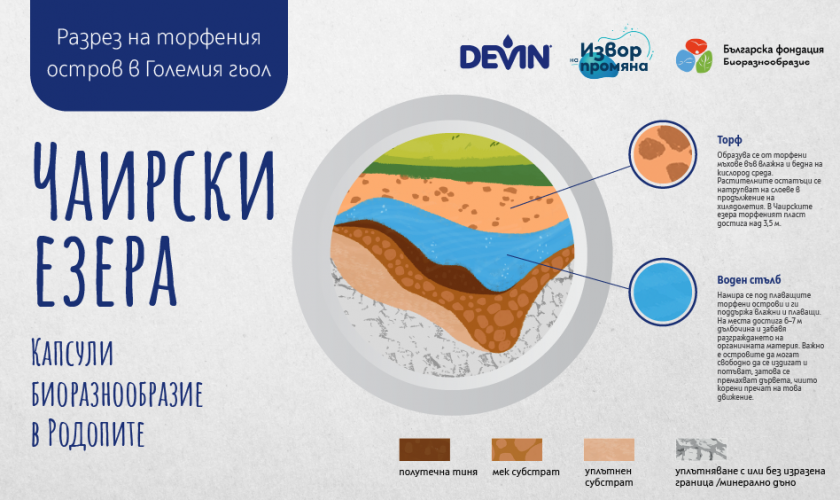
Think of a peatland as nature’s diary. Every single layer holds a page of history—past plant communities, shifting water tables, and climatic cycles that predated human civilization. In the Chairite Lakes, the peat blankets reach depths of over 3.5 meters. This staggering thickness is a testament to just how long nature has been quietly building this fortress.
-
The Living Canopy: The top tier is a vibrant, breathing carpet of peat moss and moisture-loving plants.
-
The Vault: Beneath lies the compressed peat, forged from centuries of partially decomposed organic matter.
-
The Abyss: Deeper still, under floating peat islands, lies a dynamic water column, resting on silt and dense sediment before hitting the bedrock.
This water column is the ecosystem's heartbeat. It allows the floating islands to rise and fall in perfect harmony with the seasons. When these green islands drift freely, the peatland thrives. However, if their dance is interrupted—choked by encroaching trees and aggressive root systems—the balance breaks, the islands stiffen, and the shadow of drought looms near.
Mosses: The Tiny Engineers of the Wilderness
Though easily overlooked, mosses are the true masterminds of the peatlands. These ancient survivors evolved over 400 million years ago, outliving ice ages and dramatic shifts in climate. Unlike the flora we are familiar with, mosses lack true roots or vascular plumbing to transport water. Instead, they drink directly through their leaves and stems, multiplying via spores rather than seeds.
In the peatlands, they don’t just adapt to their environment—they create it. By manipulating water retention, altering water chemistry, and arresting decay, they engineer the very conditions required for their world to exist.
"Peatlands are unique on so many levels, but first and foremost because they are built and ruled by moss," explains Assoc. Prof. Dr. Rayna Natcheva from the Institute of Biodiversity and Ecosystem Research (BAS). "In reality, peat mosses are the peatland. With their ability to alter water regimes and chemistry, they literally construct their own habitat."
They are, in every sense, nature’s micro-engineers. Without them, the peat vanishes, the wetlands dry up, and the rare, hypersensitive species that call this place home would disappear into oblivion.
Water, Life, and Quiet Majesty
The Chairite Lakes are a stronghold for rare botanical treasures that depend entirely on this delicate trinity of water, moss, and moisture. Among them are the elusive fen orchid (Hammarbya paludosa), the rare peat moss (Sphagnum obtusum), and the marsh clubmoss (Lycopodiella inundata).
The beauty of these habitats does not shout; it whispers. It thrives in the fine print—in the miniature "forests" of moss, the shifting contours of the floating islands, and the kaleidoscopic palette of the Sphagnum, which blushes from vivid green to fiery orange and deep burgundy. It is a beauty defined by its vulnerability. These systems take eons to build, yet a single careless stroke can destroy them.
The "Chairite Lakes" project, fueled by the support of DEVIN and the "Source of Change" initiative, shines a spotlight on this hidden world. It reminds us that conservation doesn't always start with the grand and obvious. Sometimes, it begins at the very bottom—with a patch of moss, the dark water beneath, and the quiet layers of peat that hold the memory of the Earth.
The Chairite Lakes are a reminder that nature has its unsung heroes. To save them, we must first learn to listen to their story.
www.devin-bg.com